
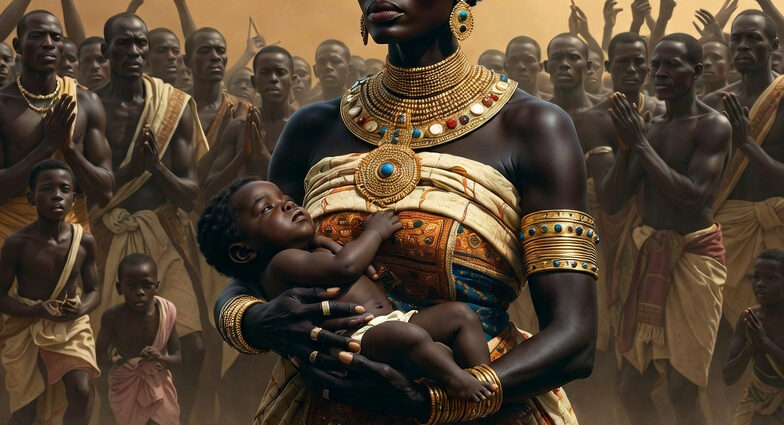
Sometimes, the fate of an entire people rests on the shoulders of a single woman.
Abla Pokou, a legendary queen of the 18th century, is one of those figures. Her courage, vision, and sacrifice led to the founding of the Baoulé people and secured a free future for thousands.
As her people fled war and instability in the territory of present-day Ghana, Abla Pokou faced a trial that would become legendary: to save her people, she is said to have sacrificed her only son to appease the Comoé River and allow them to cross safely.
From this tragic act came the very name of her people: Baoulé, derived from the words “Bâ-ouli,” meaning “the child is dead.”
Her story is not just one of migration or legend. It is the story of a woman whose courage and vision continue to inspire all those who wish to transform challenges into crowns.
Portrait of the Queen
Abla Pokou was born into Ashanti royalty. She was the sister of the defeated Dakon and the niece of King Ossei Toutou, a prominent figure of the Ashanti Confederation in present-day Ghana. At the time, the Ashanti and Denkyira peoples were engaged in continuous warfare, and succession to the throne followed matrilineal law.
After her cousin Opoku Waré’s victory, Abla Pokou, seeking to escape the authority of the new king and protect her people, decided to go into exile. She led many Ashanti with her, including her family, loyal soldiers, and all those who identified with her or her brother Dakon.
Thus began the long migration toward what is now Côte d’Ivoire. Throughout the journey, Abla Pokou revealed herself as an extraordinary leader: she guided, motivated, and maintained the unity of her people despite fatigue, danger, and uncertainty.
The Decisive Moment: The Comoé River
The crossing of the Comoé River remains the most famous moment in her story. The waters, swollen by the rains, formed an almost insurmountable barrier, while their pursuers were only a few kilometers behind.
Consulting her seer to appease the river, Abla Pokou learned that the river spirits would not calm unless they were offered what was most precious to them. The men and women tried offering valuables—gold, ivory, animals—but nothing was sufficient.
Only one ultimate offering could save the people. With unparalleled courage and a broken heart, Abla Pokou lifted her only son high above her and threw him into the raging waters. Instantly, the river receded to knee level, allowing the entire tribe to cross safely.
In memory of this sacrifice, she whispered: “Bâ-ouli” – the child is dead. This phrase became the name of the people she had led to freedom: the Baoulé. The region where they settled was named Sakassou, the “place of funerals,” in honor of this tragic yet foundational moment.
Leadership Qualities
Abla Pokou’s story illustrates timeless qualities of leadership:
Vision
She understood that her people’s survival depended on a bold migration to a safe territory.
Courage
She faced the unknown, the elements, and fear itself to protect her people.
Sacrifice
She placed the collective well-being above her maternal love—a tragic yet heroic act.
Resilience and Unity
She kept her people united and motivated despite hunger, fatigue, and danger, proving that true leadership is measured in moments of crisis.
Inspiration for Women Today
Abla Pokou is not just a queen of the past. She is a symbol for all contemporary women:
- Entrepreneurs and leaders: daring to make difficult decisions even in the face of uncertainty.
- Creators and innovators: turning obstacles into opportunities for the greater good.
- Resilient women: staying the course despite challenges and continuing to inspire others.
Her example reminds us that leadership does not depend on a title but on the courage to protect, guide, and dream—for oneself and for others.
Today’s Crown
Abla Pokou may not have worn a golden crown, but she wore the crown of courage, vision, and sacrifice.
Today, every woman who dares to make bold decisions for herself or her community follows in the footsteps of this great queen.
And you, what sacrifice are you willing to make to guide your life—or the lives of others—toward a better future?
