
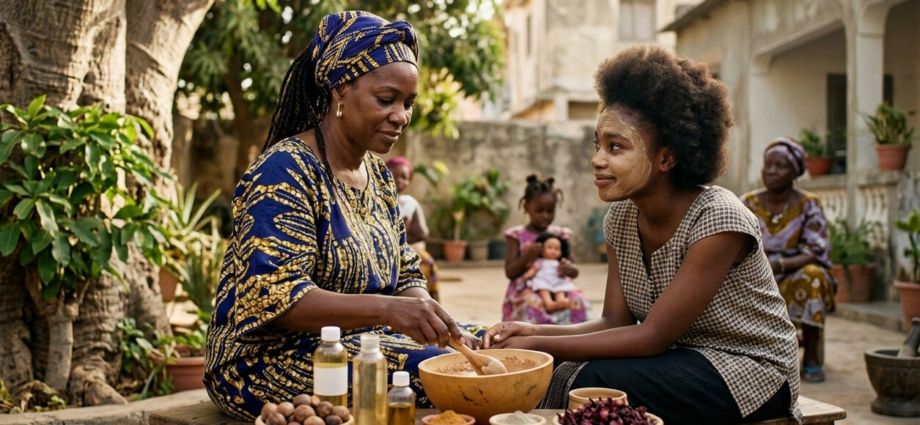
For generations, African women have known a secret that the world is only rediscovering today: beauty is not correction. It is revelation.
In sunlit family courtyards, before simple mirrors, or through the patient rhythm of braiding passed from one generation to the next, beauty has been transmitted like a silent language. Gesture after gesture, it became an act of self-love — natural, intimate, and deeply rooted.
Long before trends and instant promises, our mothers and grandmothers were already practicing a conscious form of beauty, grounded in patience, respect for the body, and a deep connection to nature.
A Living Beauty, Never Fixed
Unlike standards imposed by the global beauty industry, African beauty has never sought uniformity. It lives in diversity — in skin tones, hair textures, body shapes, and above all, in personal stories.
It is expressed through simple yet powerful gestures:
- natural oils applied slowly to nourish and protect the skin,
- protective hairstyles carrying identity and symbolism,
- evening rituals shared among women — moments of care as much as transmission.
Here, beauty is not a performance. It becomes a reconnection — to oneself, to one’s roots, and to one’s heritage.
Ancestral Rituals: A Science of Care Before Science
Long before complex serums and sophisticated formulations, there existed an intuitive understanding of the body. African beauty practices were already built upon three essential pillars:
Protection — preserving the skin from the sun and environmental stress.
Nutrition — nourishing deeply rather than correcting superficially.
Patience — understanding that true radiance develops over time.
Shea butter naturally protected the skin.
Braiding reduced breakage and encouraged hair growth.
Fragrant baths soothed both body and mind.
Today, science confirms what tradition always knew: thoughtful simplicity is often the most effective form of care.
Returning to Conscious Beauty
In a fast-moving world, these rituals remind us of an essential truth: skin does not need excess — it needs attention.
Principles inspired by this wisdom:
- cleanse the skin gently, without stripping it,
- favor raw and natural ingredients,
- hydrate consistently rather than multiplying products,
- observe your skin instead of following every trend.
Self-care then becomes a moment of presence — almost meditative — a pause to reconnect with oneself.
Beauty as Heritage and Confidence
Honoring these gestures also means honoring the women who came before us. Each ritual carries the memory of strong women who, often without naming it, were already teaching self-acceptance.
Feeling beautiful often begins the day we stop comparing ourselves and realize that our glow was never absent — only waiting to be rediscovered.
African beauty does not seek to transform. It simply reminds us who we are.
The Malkia Ritual
Gently massage your face for two minutes each evening using a natural oil, and treat your feet to a warm salt bath once a week to release tension.
Queen’s Tips
- Apply skincare products on slightly damp skin to improve absorption and hydration.
- Keep your routine simple: consistency matters more than quantity.
- Drink enough water and prioritize rest — glowing skin often starts with balance.
- Take a few minutes each day for intentional self-care; calm energy reflects on your face.
Final Glow
After taking care of yourself, strengthening your confidence, and nurturing your energy, you begin to shine naturally. It’s not only about appearance, but about an inner light that reflects in your attitude, your smile, and your presence.
Take this moment to appreciate your growth, celebrate your efforts, and recognize the strong and radiant woman you have become. Your glow does not come only from the outside; it comes from the love you give yourself, your confidence, and the peace you build within.
Remember: true glow is not a destination—it is a mindset you carry with you every day.
A queen does not search for the light… she creates it.
