
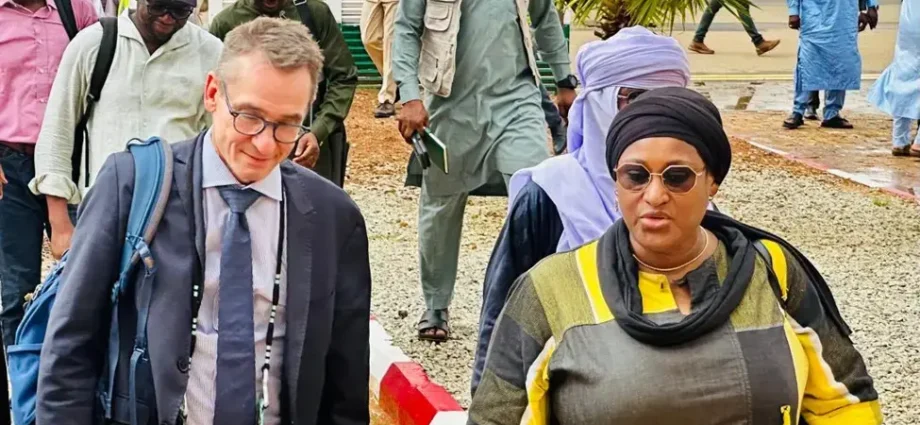
On June 3, 2026, the Tahoua region hosted a delegation led by Ms. Boukar Yagana, Deputy Secretary General of the High Authority for Peacebuilding (HACP), as part of a high-level mission by Mr. Brian J. Williams, Director of Financing at the United Nations Peacebuilding Support Office (PBSO). This mission, focused on initiatives supported by the United Nations Peacebuilding Fund (PBF), aimed to assess the results of investments made to promote peace, social cohesion, and women’s leadership in the region.
The delegation included Ms. Boukar Yagana, Deputy Secretary General of HACP; Mr. Brian J. Williams, Director of Financing at PBSO; Ms. Temaizian Aline Napon, UN Women Representative in Niger; Mr. Jean-Claude Cigwerh, PBF Coordinator; Mr. André Sourou Yebadoko, UNFPA Deputy Representative; and Mr. Paul Hovi Moussa, Coordinator of Women, Peace and Security Projects at UN Women Niger.

The mission began with a visit to the Governor of Tahoua, who expressed his appreciation to the PBF, UN Women, and their partners for their support to conflict prevention efforts, strengthening social cohesion, and promoting women’s participation in local peace and security mechanisms. According to him, “the observed results reflect a significant evolution in community dynamics, with women and youth involved in dialogue and mediation spaces, actively contributing to social stability and the prevention of tensions.”
Following this meeting, the delegation visited the Saraounia Space, a space for dialogue, mediation, and women’s empowerment established by UN Women with funding from the PBF under the GPI 2.0 project. This space has become a genuine hub for social cohesion, providing women with an enabling environment to develop their mediation skills, strengthen their leadership, and implement initiatives benefiting their communities.

Members of the delegation engaged directly with women beneficiaries of PBF-funded projects. Through their testimonies, they gave a human face to the results achieved. They explained how training, support, and income-generating activities now enable them to contribute to peaceful conflict management, facilitate dialogue between communities, strengthen social cohesion, and improve their financial autonomy.
Among them, Ramatou Issaka, a mediator in the Tahoua region and member of the Regional Consultative Council of the Refoundation, highlighted the project’s tangible impact on her journey.

She expressed gratitude to the PBF and UN Women for strengthening women’s capacities in the region. Thanks to this support, she now holds a role within a decision-making body, illustrating progress in women’s participation in local governance.
She also called for the continuation and expansion of these initiatives so that communities not yet benefiting can gain access. According to her: “the creation of an international network of women mediators would help strengthen experience sharing, best practice exchange, and women’s collective contribution to peace efforts across different contexts.”
Discussions at the Saraounia Space demonstrated that when women are provided with the necessary knowledge, resources, and opportunities, they become genuine agents of change, capable of preventing conflict, promoting dialogue, and strengthening community resilience.

This perspective was echoed by Brian J. Williams, who stated that:
“Peace is first built at the local level, and women represent one of its strongest foundations. Their courage, their commitment, and their ability to make their voices heard are essential to building more peaceful and resilient societies.” He also stressed the close link between economic empowerment and peacebuilding, noting that improving livelihoods enables women to participate more actively in decision-making processes and positively influence the future of their communities.
The visit also enabled the delegation to meet with prefects and delegated administrators of the region. These exchanges highlighted several good practices developed through PBF-supported projects, as well as progress in strengthening collaboration between local authorities, community leaders, and women’s organizations.

According to the UN Women Representative in Niger, “the initiatives implemented in Tahoua clearly demonstrate that women are at the heart of sustainable peace solutions. The commitment of women mediators, their resilience in the face of challenges, and their daily contributions to conflict prevention illustrate the concrete results achieved through targeted investments in women’s leadership.”
Beyond a simple field visit, this mission served as a tribute to women working every day to bring communities closer together, prevent tensions, and promote dialogue. The Saraounia Space now stands as a living symbol of this dynamic, demonstrating that when women are placed at the center of peacebuilding strategies, the results are tangible, inclusive, and sustainable.
The Peacebuilding Fund (PBF), the United Nations’ main financial mechanism dedicated to conflict prevention and peacebuilding, supports initiatives for inclusive and sustainable peace through voluntary contributions from several Member States and international partners, including Germany, the United Kingdom, Sweden, the Netherlands, Switzerland, Canada, Norway, and Japan.
At Tahoua, the results observed reaffirm a key reality: women are not only beneficiaries of peace initiatives, but they are also their primary builders, paving the way for more resilient, inclusive, and peaceful communities.
Source: UN Women Africa
